Announcements
Get to Know Us
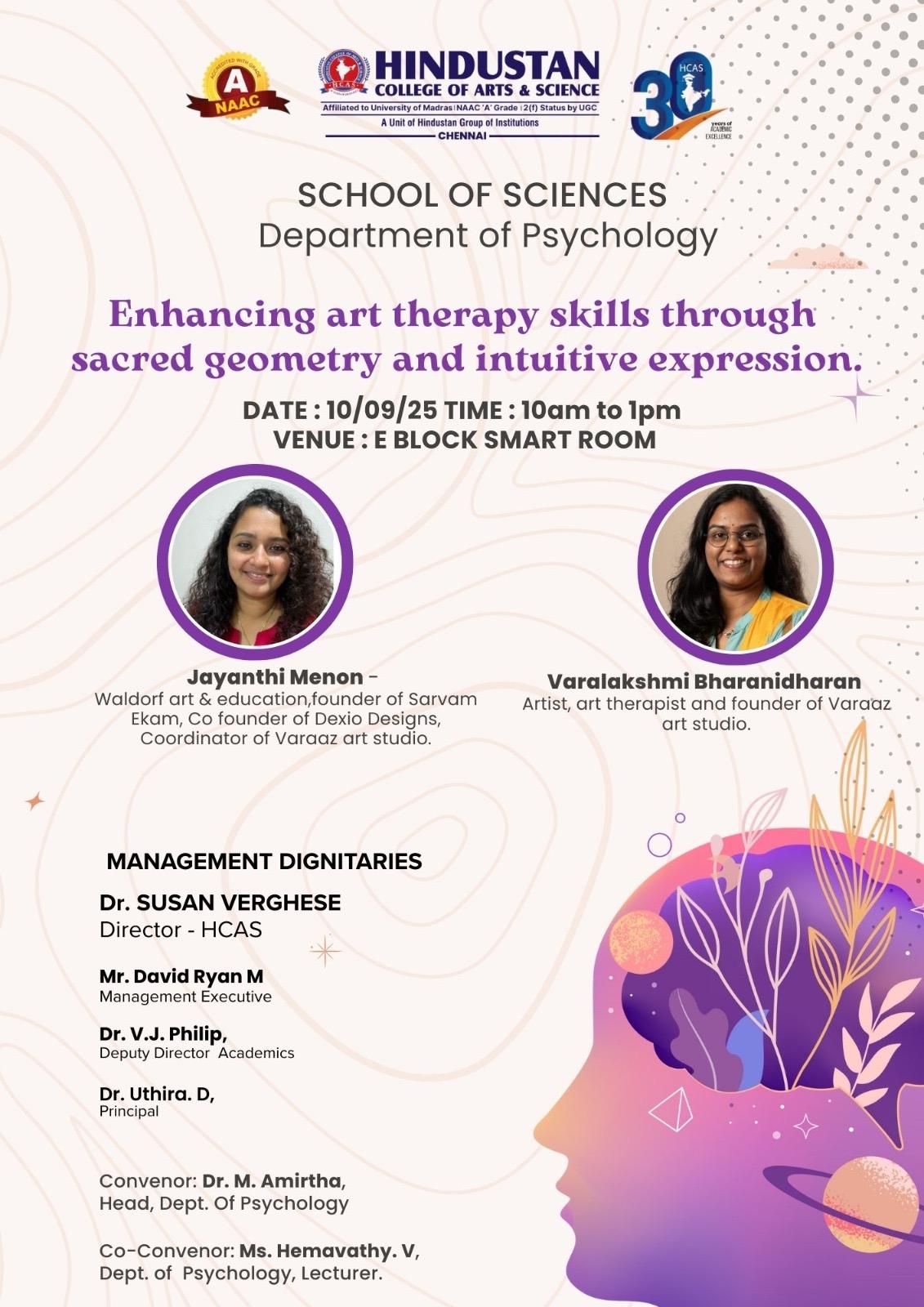
Enhancing art therapy skills through sacred geometry and intuitive expression on 10th september 2025
Enhancing art therapy skills through sacred geometry and intuitive expression on 10th september 2025
2025-09-10
09:00
HCAS, Chennai
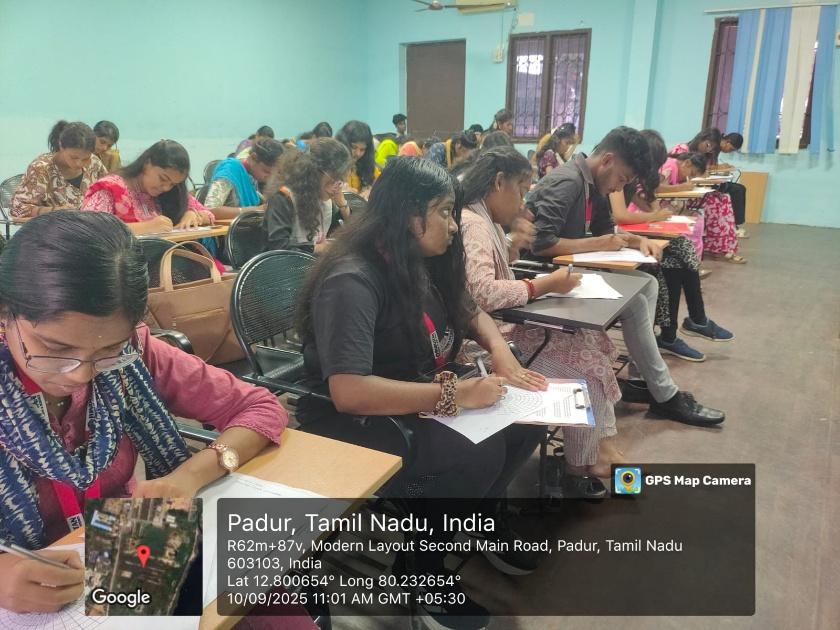
The event “Enhancing art therapy skills through sacred geometry and intuitive expression”, was headed by Ms Varalakshmi Bharanidharan, a art therapist and the founder of Varaaz art studio and Ms Jayanthi Menon, Waldorf art & education, founder of Sarvam Ekam, co-founder of Dexio designs, and co-ordinator of Varaaz art studio.They began the session by asking the students what they know about mandala art therapy, and how they feel it may benefit people. They continued by making the students hear modulate frequency for about 10 minutes to ground the mind of the students. They asked the students how they felt throughout that time, highlighting the factors of their senses, thoughts and experience. They highlighted the importance of mindset and mind power. Jayanthi Ma’am asked everyone to blindfold themselves with the shawls they had brought and spoke about the flow state of mind (subconsciousness and consciousness) and spoke about consistency state. The students were instructed to freely draw on the piece of paper, wherever their mind lead them. The second activity, a grid sheet with a mandala design was prescribed to all the students. They were instructed to fill the grids with unique designs circling around. They were also given colour pencils to show their creativity. The chief guests explained about how art therapy is unique, allows to express emotions.They explained that each pattern and curve had meaning, and they explained the importance of them, and how they denote certain factors of the mind.
They highlighted a very crucial topic being dialectical behaviour therapy and cognitive behaviour therapy, and how they are parallelly supported using a mandala framework, symbolizing harmony between change and acceptance. At the core of the mandala lies their shared goal of improving emotional regulation, reducing distress, and fostering healthier coping skills. On one side, CBT emphasizes identifying and restructuring maladaptive thought patterns by exploring the connection between thoughts, emotions, and behaviours, thereby promoting rational problem-solving.
On the other side, DBT focuses on mindfulness, acceptance, distress tolerance, and interpersonal effectiveness, helping individuals navigate intense emotions with balance and validation. The age group for this form of therapy is for individuals above the age of 10. Even impaired/ challenged people get benefitted by this form of therapy.
They spoke about how geometry has the power to hold memory. It is because shapes, patterns, and spatial arrangements act as symbolic containers of human experience and meaning. Throughout history, geometric forms have been used in art, architecture, and cultural practices to represent knowledge, preserve traditions, and evoke collective memory. On a cognitive level, humans are naturally wired to recognize and recall patterns; geometric forms are simple, structured, and universally recognizable, making them powerful tools for storing and transmitting memory across time and generations.
The session was concluded with a PowerPoint presentation, that highlighted all the various aspects of mandala, and therapy methods, signifying there lies a structure everywhere. They also spoke about the seven hermetic principles, along with a case study. It finally ended with a group photograph, where everyone showcased their mandala arts
Event Gallery