Who Owns Your Attention?

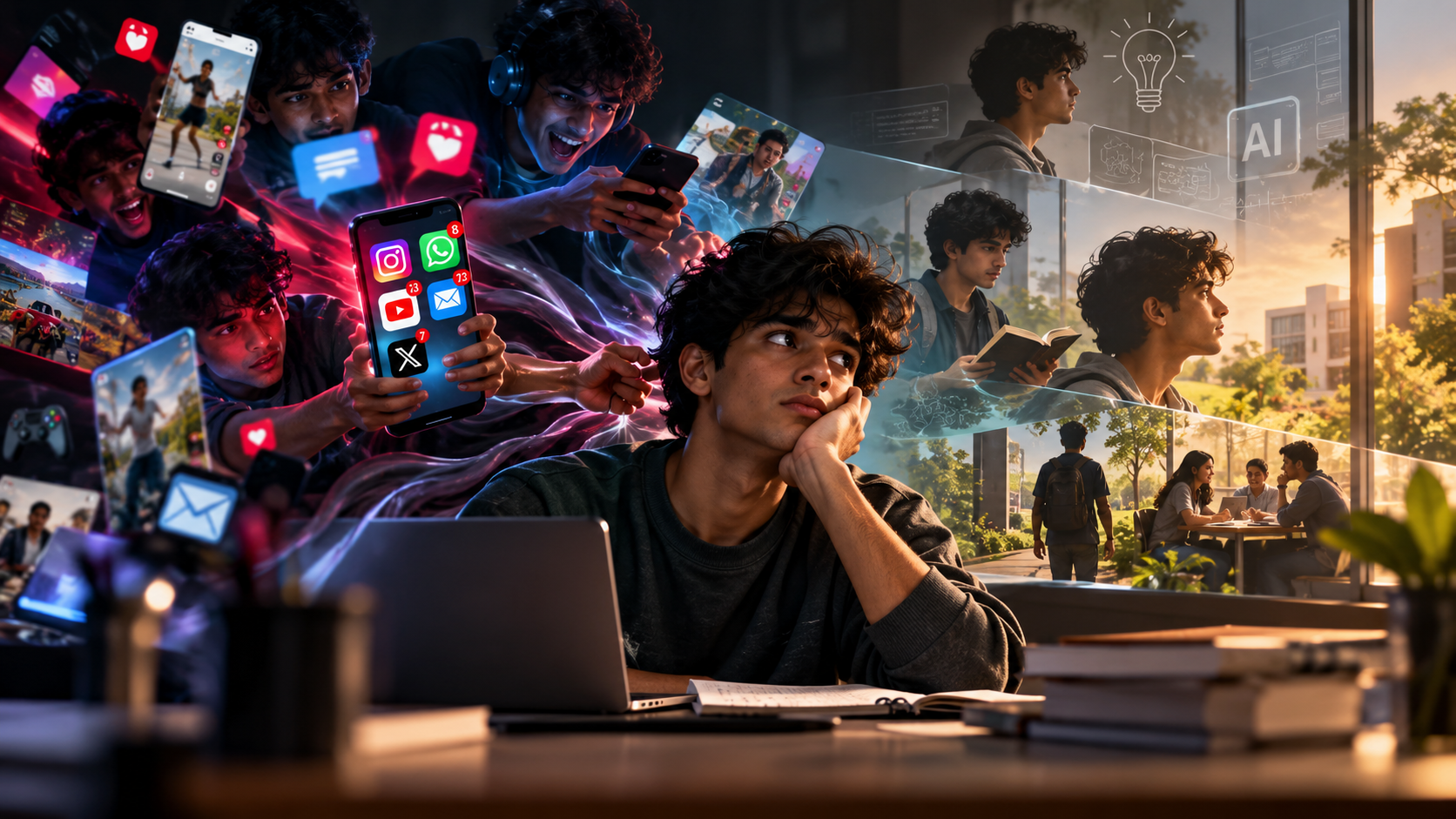
Your phone may be in your hand.
But who is holding your attention?
A student walks into my office.
While talking to me, the phone lights up.
A quick glance.
WhatsApp. Instagram. An email. A notification.
Nothing unusual.
In fact, it has become so normal that we barely notice it anymore.
And yet, it makes me wonder:
Who actually owns our attention?
We often say that today’s students have short attention spans. We complain that they cannot sit through a lecture without checking their phones.
But perhaps we are asking the wrong question.
What have we built a world that constantly demands their attention?
Think about an ordinary day.
You wake up and check your phone.
You travel while scrolling.
You attend a meeting while occasionally checking notifications.
You eat while watching something.
You go to bed with one final scroll.
Except there is never really a “final” scroll.
There is always one more notification.
One more reel.
One more message.
Our attention has become a commodity.
Apps compete for it. Advertisers compete for it. Platforms compete for it.
And slowly, we have stopped noticing that our attention is being taken from us.
But attention is much more than concentration.
Where our attention goes, our time follows.
Where our time goes, our habits follow.
And our habits eventually shape who we become.
That makes attention not just a productivity issue.
It is a life issue.
We have also become uncomfortable with boredom.
Waiting for a lift? Phone.
Waiting for a friend? Phone.
Waiting for class? Phone.
Travelling? Phone.
But perhaps boredom isn’t the enemy.
Some of our best ideas emerge when the mind isn’t being constantly fed with information.
A quiet walk.
A conversation.
Looking out of a window.
Doing absolutely nothing.
These moments give the mind something technology cannot always provide:
space to think.
And now, AI has added another dimension.
AI can explain.
AI can summarise.
AI can write.
AI can brainstorm.
Wonderful.
But the question we must ask is not only:
“Can Artifical intelligence do this?”
It is:
“Should I let AI do this?”
A student who uses AI to understand a difficult concept is using technology intelligently.
A student who uses AI so they never have to struggle with the concept may be giving away something far more valuable than an assignment the opportunity to think.
So perhaps we don’t need to throw away our phones.
We simply need to reclaim some ownership over our attention.
Read without checking your phone.
Have a conversation without looking at a screen.
Sit with a difficult problem before asking AI for the answer.
Allow yourself to be bored.
And remember:
Not everything that demands your attention deserves it.
Dear students, the future will not suffer from a shortage of information.
You will have more information than any generation before you.
Your advantage may therefore not be knowing more.
It may be your ability to focus longer, think deeper, listen better and create independently.
So, the next time your phone lights up, pause for a second.
Ask yourself:
“Is this something I need to give my attention to or simply something that is asking for it?”
Because attention is one of the few things we give away without realising its value.
And once a moment is gone,
it cannot be downloaded again.
— Dr. Uthira D
Principal, Hindustan College of Arts and Science
tag:
AI and Education Attention Span Beyond the Classroom College Students Critical Thinking Education and Technology Digital Age Digital Distraction Digital Wellbeing HCAS Hindustan College of Arts and Science Independent Thinking Social Media student Attention Student Focus Student Life Technology and EducationShare:

Digital Marketing