
The Rise of Anonymous Aid: How AI Chatbots Challenge Traditional Social Work

When young people need support, are they turning to human social workers or seeking answers from AI chatbots?
Imagine a young adult struggling with emotional distress or family problems. Instead of reaching out to friends, family or a professional, they open an AI chatbot and share their concerns. No appointment, no waiting and seemingly no fear of judgment.
This reflects a changing pattern in help-seeking behaviour. While traditional support comes from human relationships, AI chatbots are becoming another option for young people seeking guidance. This creates a growing tension between human social work and AI-driven anonymous aid.
What Is Human Social Work?
Human social work is a profession centred on interpersonal relationships, social justice and understanding people’s lived experiences.
How it works: Social workers assess individuals within their social, physical and emotional environments to provide holistic support.
Core values: Human dignity, individual worth, ethical responsibility and non-judgmental acceptance.
Main benefit: Social workers provide community resource navigation, crisis intervention, advocacy and genuine human connection that supports long-term resilience.
What Is AI-Driven Anonymous Aid?
AI-driven aid involves generative AI tools and conversational chatbots, such as ChatGPT, Gemini, Claude and DeepSeek, offering automated guidance and emotional support.
How it works: AI models process user prompts and generate conversational responses, often around the clock.
Key features: Immediate access, perceived privacy, convenience and a digital space that may feel less intimidating.
Main benefit: Chatbots offer a low-barrier starting point for young people who fear stigma, judgment or privacy breaches when discussing personal concerns. However, perceived privacy does not guarantee complete anonymity or confidentiality.
Real-World Realities: When Digital Aid Lacks Human Safeguards
Reports surrounding a Massachusetts case involving a teenager accused of killing family members raised questions about AI safety after he reportedly used ChatGPT to explore fictional scenarios involving violence. The case does not establish that AI caused the crime, but it highlights concerns about how chatbots respond to potentially dangerous conversations.
Unlike trained social workers, AI systems cannot independently assess someone’s complete circumstances, intervene in physical emergencies or provide accountable professional care. They can also generate inaccurate or inappropriate responses, making safeguards essential.
Human Connection vs. Algorithmic Accessibility

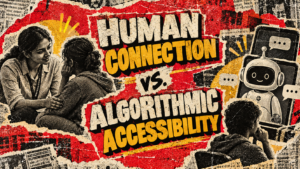
The main difference lies between human connection and digital accessibility. Social workers offer contextual understanding, professional judgment and real-world intervention, while AI provides convenience and immediate responses.
Ironically, young people may seek AI because they want a private, non-judgmental space—qualities that are also central to ethical social work. However, supportive language does not equal genuine human empathy or professional accountability.
Why Does This Shift Matter?
Overreliance on chatbots may create a false sense of connection, spread misinformation or delay professional help. Yet, AI could also serve as a complementary digital intermediary, helping users understand their concerns and guiding them towards qualified professionals when necessary.
Social workers and researchers must understand this shift to develop safe, human-centred digital interventions that protect privacy and preserve human dignity.

Conclusion
AI chatbots may offer an accessible first step for young people seeking support, but accessibility alone cannot replace professional social work. The future lies in combining digital convenience with ethical responsibility, human connection and appropriate professional care.
AI can open the door to support, but human care remains essential.
— Mr. Kumaran S. (MSW-T033)
Assistant Professor, Department of Social Work, HCAS
tag:
AI and Human Connection AI Chatbots AI Safety Anonymous Aid Artificial Intelligence Chatbot-Based Support Department of Social Work Digital Mental Health Support Digital Social Work Emotional Support HCAS Hindustan College of Arts and Science Human Empathy Professional Social Work social work Social Work Ethics Technology in Social Work Youth Mental HealthShare:

Digital Marketing