The Confidence Gap: Why Capable Students Don’t Raise Their Hands

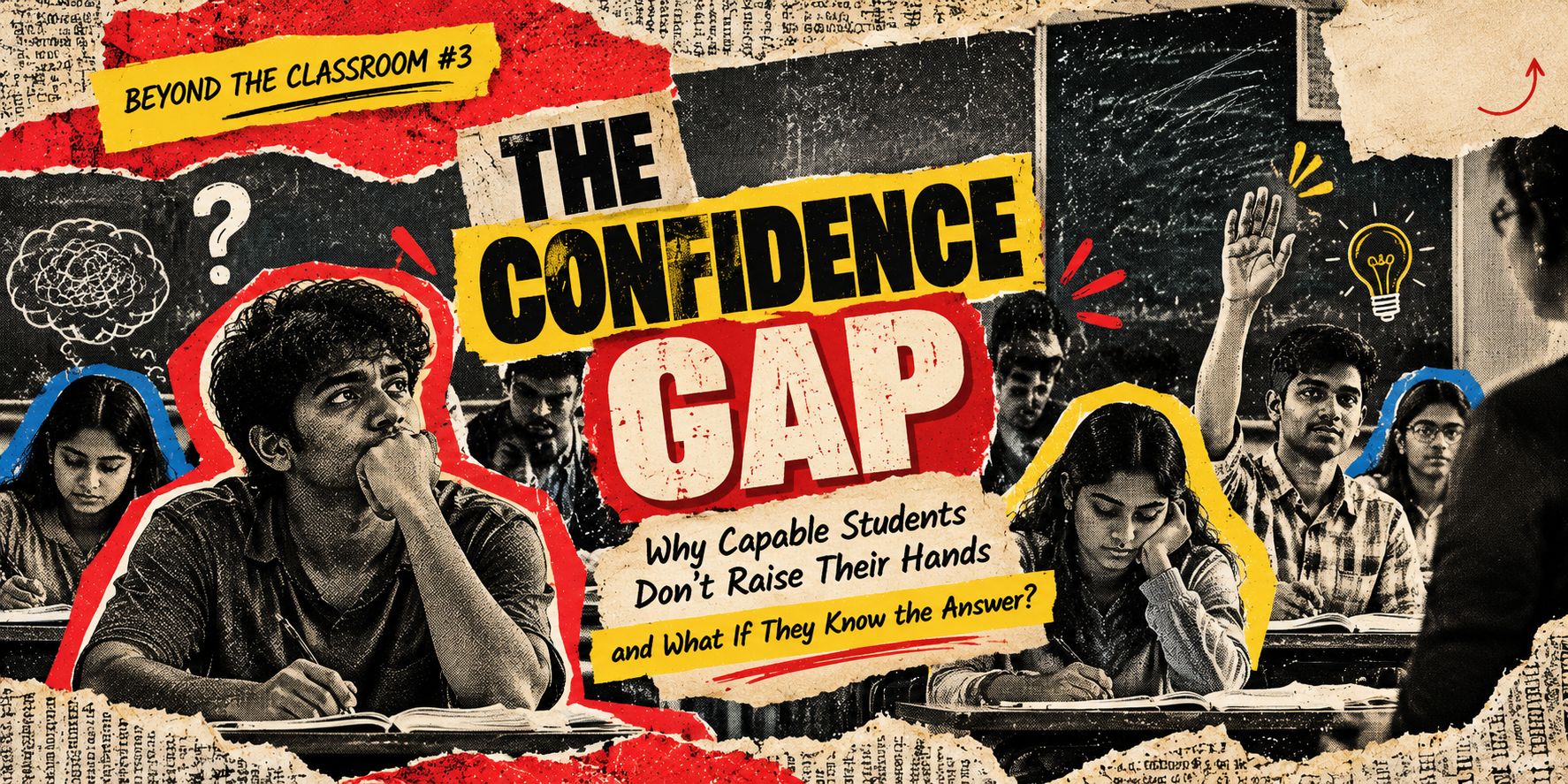
The Confidence Gap: Why Capable Students Don’t Raise Their Hands
Why fear of judgment keeps capable students silent and how educators can help them find their voice.
Look Around a Classroom
Student confidence in the classroom plays an important role in how students participate, express their ideas and respond to questions. Look around a classroom: the teacher asks a question, but silence follows. A few students look down, some become interested in their notebooks, and the same two or three hands go up.
We often assume:
Hands up = confident + capable.
Silence = unprepared + unsure.
But is that really true?
Research suggests otherwise.
A study involving 417 undergraduate students found that more than half were uncomfortable asking or answering questions in front of the class. 72.5% said they felt uncomfortable when they were not confident about their knowledge, while 67.5% worried about being judged by their peers.
So perhaps the student who doesn’t raise a hand isn’t thinking:
“I don’t know.”
They may actually be thinking:
“What if I’m wrong?”
“What will everyone think?”
“What if my English isn’t good enough?”
And the hand stays down.
Silence is not always a lack of knowledge.
This tells us something important:
Participation is not simply a personality trait.
It is influenced by confidence, fear of judgement, classroom environment, preparation and the way we respond to mistakes.
So, what is confidence?
We often tell students:
“Be confident.”
But confidence doesn’t appear because someone tells us to have it.
Psychologists often use the term self-efficacy our belief in our ability to successfully perform a particular task.
Research shows a two-way relationship between self-efficacy and academic performance: success can strengthen confidence, while stronger confidence can support future performance.
It creates a cycle:
Try → Succeed → Gain confidence → Try something harder.
But the reverse can happen too:
Fear → Don’t participate → Don’t practise → Lose confidence → Fear even more.
This is where teachers matter.
Imagine a student gives a wrong answer.
One response:
“No. That’s wrong.”
Another:
“Interesting. Tell me how you arrived at that answer.”
The content hasn’t changed.
But the learning environment has.
The first response can close a conversation.
The second keeps the student thinking.
Perhaps our responsibility as educators is not simply to produce students who know the answer.
It is to create students who are willing to ask the question.
So, how do we build confidence?
Not by forcing every student to speak before they are ready.
Instead:
Think → Pair → Share → Present → Lead.
Let students first think individually, discuss in small groups, share with peers and gradually move towards larger audiences.
Because participation has many forms.
And confidence is often built through small victories.
To the student who never raises a hand
Your silence does not mean you are incapable.
Your answer doesn’t have to be perfect.
Your English doesn’t have to be perfect.
You might get it wrong.
Raise your hand anyway.
A classroom is not a place where you are expected to prove that you already know everything.
It is where you learn to think, question, speak, listen—and sometimes be wrong.
The student who always raises a hand isn’t necessarily the most capable person in the room.
And the student who never does may not be the least capable.
There may simply be a confidence gap between what a student knows and what a student is willing to show.
Our job as educators?
Make that gap smaller.
Beyond the Classroom
Reflections on education, life and the world around us.
— Dr. Uthira D
Principal, Hindustan College of Arts and Science
tag:
Academic Self-Efficacy Beyond the Classroom Classroom Environment Classroom Participation Confidence Gap Dr Uthira D Education Psychology Fear of Judgement HCAS Higher Education Hindustan College of Arts and Science Learning Through Mistakes Public Speaking Student Communication Skills Student Confidence Student Engagement Teaching StrategiesShare:

Digital Marketing